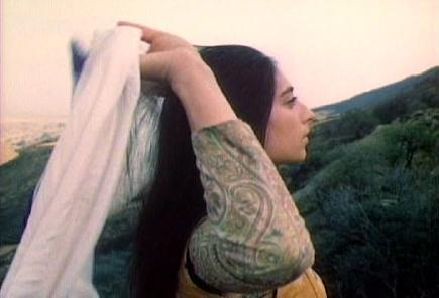
I'm still reeling from my discovery of Paradjanov yesterday, especially the second of the two films I saw: The Legend of Suram Fortress (the other was Shadows of Our Forgotten Ancestors, which though less perfectly achieved, has some of the finest forest photography I've ever seen, almost on a par with King Hu and Terrence Malick).
What's quite unique in this film is Paradjanov's unashamed attempt to portray nothing less than the whole world, which shines through most aspects of his film-making here.
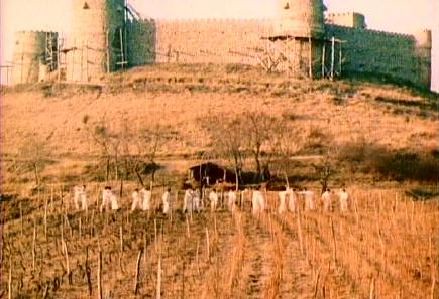
Every shot in that film is complete and needs nothing more to convey what has to be conveyed. This is not to say that the frame is sealed off: people and animals can enter it or leave it. But once outside it, they might as well cease to exist (as do the son's retinue in the magician's den, toward the end). The idea of off-screen space or cutting along the axis is completely foreign to Paradjanov in this film: each shot is completely fulfilled. Everyone involved in the action is always on screen, and if ever a character addresses someone off screen, it is the audience, which will never, in this film, get or even need a point of view other than the one Paradjanov sets at the beginning of each of his event-chapters. Yet the claim to totality in this film is not that of classical film-making, which also seeks to represent the totality of the action, for the very simple reason that the action is Suram Fortress is presented to the audience without involving the audience in it: for Paradjanov, space is rich, diverse, infinite, but impenetrable.
This is reflected in the narrative, which is brought to a quasi biblical simplicity of means (And Moses said... And God saw that it was good). That's not to say that Paradjanov is uninterested in his story. He's very interested in his tale, but not really as a story, more as a succession of moments of key importance. Every single step is essential in his progression, yet the impression is not that of a narrative unraveling, but of events aggregating. Paradjanov goes for almost complete paratax, relying on our ability to identify places and make connections between location, character and event, and as such is incapable of creating anything like suspense (here too he differs from the classical approach to the complete narrative: there is no construction of a narrative, only eternal present moments amassing like grains of sand in an hourglass, until suddenly the hourglass tips). What he can create, however, is moments of monumental importance: since every one stands on its own, only implicitly a consequence of former events, each one echoes like a miracle.
Any action in any frame is both a culmination of former events, a reinvention of all former actions and an absolutely complete unity: every shot reinterprets the whole film before it.

(Note of frustration: the ending of this masterwork was ruined for me by the man sitting next to me, at the very end of the row I was sat on; this anti-social creature decided, during what was obviously the very last shot of the film, with only seconds to go before the credits, to get up and exit, forcing every single person on our row to let him pass. I've seen some annoying behavior at the cinema before, but in terms of sheer stupidity, this trumps all).
 If we posit the beginning of the decade, in film terms, with Movie Mutations, in 2003, and if we consider that the number of internet users worldwide has increased by 400% between 2000 and 2009, how gloriously long will this decade turn out to be?