Wednesday, 19 May 2010

Epics and Lists

One figure of style that seems to have gone out of fashion is the list. It survives in cinema only as the most conventional montage of, say, images of a city (children and pigeons in the park, people walking in the street, to show us all the lives that will be lost in Rock, for example; or a montage of images of the loved one, now dead; stuff like that), that functions not on the principle of heroic accumulation, but of signifying what they represent (so that in fact, in all those cases, one image should be enough).
But think back to most of the great epic poems, Homer, Virgil, or even other literary models (Shakespeare, Dante, Farid Ud-Dinn Attar, the Ramayana), and they are teeming with lists, lists of enemies killed, or valiant heroes, or extraordinary deeds... They function on a dynamic principle that all elements gain a critical mass from being together, complement each other to a certain degree (it is not enough for the wise hero to be included, if the brave hero, strong hero, cunning hero, good-spirited hero... are not as well).
I was reminded of these moments as I watched the scene in Go-Go Tales in which Ray introduces all the girls to his (almost non-existent) audience: here is a list in all its purity, a rattling of names, an accumulation of bodies that ends up embodying not the abstract idea of "the strip club", but the reality of its community, with its inner tensions (the dancer who refuses to dance, the one who asks for money) and its outer pizazz. Abel Ferrara does something quite amazing: he lists parts to show that the image they call up is more than the sum of them (if that's not dialectical film-making...).

And footnote: Brad Stevens is tremendously helpful in linking this to Le Crime de Monsieur Lange.

Thursday, 15 April 2010

"The Decade" est mort, vive "The Decade"!

"If one adopts a cyclical theory of film history, the next golden age of internationalism will be the first decade of the next century."
Jonathan Rosenbaum, September 1987.


If we posit the beginning of the decade, in film terms, with Movie Mutations, in 2003, and if we consider that the number of internet users worldwide has increased by 400% between 2000 and 2009, how gloriously long will this decade turn out to be?

Monday, 12 April 2010


"L'art moderne doit se montrer à la hauteur de la grande industrie et non pas se contenter de la prendre pour thème", Adorno, Aesthetic Theory.
Que dire d'un film qui fait les deux?

Sunday, 11 April 2010

Scales

Pitching two directors "against" one another is more useful as a way of comparing approaches than as a way of making value judgements. So when I compare Jia Zhang-ke's 24 City and Wang Bing's Tie Xi: West of the tracks, it's clear to me that both films are truly great, among the key events of the decade in terms of cinema.

Yet what vast differences! I just saw 24 City again a few days ago to write about it in the student paper and concluded that Jia was more interested in truth than reality. Wang Bing is almost completely interested in reality, but truth shines out of his work just as much as it does from Jia's, though in very different ways. The two most striking differences lie in the fact that firstly, Wang Bing shows people working, which Jia almost doesn't do at all, and secondly, that while Jia films a factory on the scale of cinema, Wang films it to the scale of men, elevating cinema to the scale of the factory rather than vice-versa. This is most apparent in his travelling shots (I'm here referring to Rust I and Rust II, not the long shots taken from trains in Rails): they exist only as the steps of the cameraman walking through a space. No smoothness of aesthetic gestures enabled by the cinematic apparatus (dollies, steadicams...). A camera, placed slightly lower than eye level, accompanying every step Wang Bing makes. Whether the factory unfolds as a monstrous space, or as a wonderful one, or a desolate gradeur, it is the way it unfolds to an individual: any gesture, for WB, will start there, with the simplest, richest scale there is: 1:1.

Friday, 5 March 2010

The Whole World


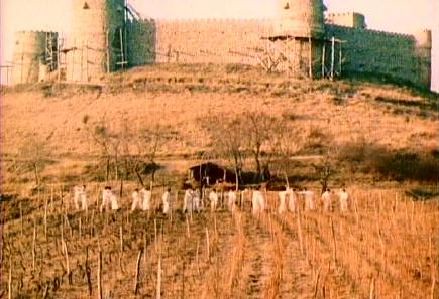
I'm still reeling from my discovery of Paradjanov yesterday, especially the second of the two films I saw: The Legend of Suram Fortress (the other was Shadows of Our Forgotten Ancestors, which though less perfectly achieved, has some of the finest forest photography I've ever seen, almost on a par with King Hu and Terrence Malick).
What's quite unique in this film is Paradjanov's unashamed attempt to portray nothing less than the whole world, which shines through most aspects of his film-making here.
Every shot in that film is complete and needs nothing more to convey what has to be conveyed. This is not to say that the frame is sealed off: people and animals can enter it or leave it. But once outside it, they might as well cease to exist (as do the son's retinue in the magician's den, toward the end). The idea of off-screen space or cutting along the axis is completely foreign to Paradjanov in this film: each shot is completely fulfilled. Everyone involved in the action is always on screen, and if ever a character addresses someone off screen, it is the audience, which will never, in this film, get or even need a point of view other than the one Paradjanov sets at the beginning of each of his event-chapters. Yet the claim to totality in this film is not that of classical film-making, which also seeks to represent the totality of the action, for the very simple reason that the action is Suram Fortress is presented to the audience without involving the audience in it: for Paradjanov, space is rich, diverse, infinite, but impenetrable.

This is reflected in the narrative, which is brought to a quasi biblical simplicity of means (And Moses said... And God saw that it was good). That's not to say that Paradjanov is uninterested in his story. He's very interested in his tale, but not really as a story, more as a succession of moments of key importance. Every single step is essential in his progression, yet the impression is not that of a narrative unraveling, but of events aggregating. Paradjanov goes for almost complete paratax, relying on our ability to identify places and make connections between location, character and event, and as such is incapable of creating anything like suspense (here too he differs from the classical approach to the complete narrative: there is no construction of a narrative, only eternal present moments amassing like grains of sand in an hourglass, until suddenly the hourglass tips). What he can create, however, is moments of monumental importance: since every one stands on its own, only implicitly a consequence of former events, each one echoes like a miracle.
Any action in any frame is both a culmination of former events, a reinvention of all former actions and an absolutely complete unity: every shot reinterprets the whole film before it.


(Note of frustration: the ending of this masterwork was ruined for me by the man sitting next to me, at the very end of the row I was sat on; this anti-social creature decided, during what was obviously the very last shot of the film, with only seconds to go before the credits, to get up and exit, forcing every single person on our row to let him pass. I've seen some annoying behavior at the cinema before, but in terms of sheer stupidity, this trumps all).

Monday, 15 February 2010

Just for the pleasure

My favorite scenes in Pretty in Pink are, pretty predictably, all the ones involving Ducky. Obviously, the disc shop scene is a monument, as is the one when he talks to the bouncer. But what strikes me in both cases is how little dramatic justification these two scenes have. They're there just for the pleasure of spending time with a character who ends up being a lot more than just the foil to the girl (which James Spader ends up being for the boy, although his charisma saves him). Duckie is the one stray element in the film, infinitely more physical than Molly Ringwald or Andrew McCarthy, and though he's probably, with Harry Dean Stanton, the one who suffers most in the film, he's the one most capable of inhabiting his body with sheer joy.

Likewise, Ferris Bueller's Day Off is one long string of scenes that are just for the pleasure. Which is why the least convincing bits (though they are still fun) are the ones involving Jeffrey Jones once Sloane has been picked up from school. They're there to provide some sort of narrative stake, which goes against the grain of the rest of the film: that day off is one big digression.

Also, what is it about museums and perfect scenes? Two great films find their souls in them.