Tuesday, 29 September 2009

La Vie nouvelle


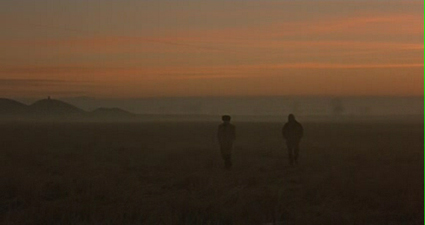
La Vie nouvelle is the nightmare of western civilization faced with the catastrophe of its own existence.


I'm still too puzzled and overwhelmed to write anything more coherent than that, but I'll try. I haven't seen Sombre yet, but so far I prefer Grandrieux working with negatives rather than positives (Un Lac), even though admittedly negative effects are easier to reach than quieter ones (the soudtrack goes a long way in L.V.n.); the reason for this may be that in Un Lac, as pointed out in Spectres du Cinema, the fable form which insists on a-historicity, even when the intruder shows up, only partially convinces me, for the very reasons that are sketched out in the opening sequence of La Vie nouvelle: those faces, staring at the catastrophe, know that there is no Eden possible anymore. Maybe Un Lac was the tale of its loss, I'd have to watch it a second time (I'll have to watch it a second time anyway, I can't even pretend that I got a firm grasp on it the first time, let alone understood it), but the violence of La Vie nouvelle resonates more with me than the attempts to reclaim its preceding innocence.

The dance scene may be one of the single most thrilling (and blood-chilling) film moments of the last decade, akin to very few others I can think of. Its dialectic of control and freedom, of alienation within a crowd (the pimp and his creation first dance alone, bring their bodies to a climax, then go on dancing to the same music, in the same space, that is now filled with people), of possession/independence of the human body, make it the key moment of the film for me. Boyan is the greatest incarnation of the devil on screen that I can think of right now, and nowhere is this more evident than in this sequence, where the seduction of the primary pulsions that Grandrieux is so interested in, and that cause the disaster we are continually witnessing, is laid bare in a giddy swirl of Dionysiac liberation/enslavement (the only other scene that matches this plays exactly like a trip to hell: the thermic scene).


Probably more on this soon...

Tuesday, 15 September 2009

Springtime in Berlin

Kino Arsenal's Room 2, in Berlin, seems to hold a treat that I never thought I would actually encounter ready for every time I come to Berlin: last time, a pristine copy of Paul Fejos's Lonesome, this time, a raesonably good copy of Fei Mu's Springtime in a Small Town. Both masterworks, though radically different ones. But seriously, has that spot been chosen by angels?
Fei Mu knows how to frame two characters and their interactions better than 99% of directors I can think of right now: though the whole film is superb and the group scenes are marvellous, the film's defining moments are its intimate scenes between two characters, where he sometimes inserts a fade and a change of camera position between a question and its answer (oh, and the agreeable little irony of seeing a film in which a wall plays such a prominent role in Berlin of all places). His mastery of the long take reminds me of Ophuls more than anybody else, but their worlds are completely different: Fei Mu is almost completely indifferent to decorum.

Saturday, 29 August 2009

Inglorious...


-Does anyone agree with me that Tarantino makes the same film as Joseph Goebbels?

-The only good image of the film is that of Shosanna's face being projected on the smoke of the burning theater, the screen having already been destroyed by the flames.


-Coincidentally, one of the most beautiful images of Assayas's Demonlover is Connie Nielsen being shown the proof, on a mini-DV camera, that she did indeed kill another woman. A true foray into the means of projection (cringe) in the modern world. Assayas seems to believe, and kudos to him, that digital cinema can still testify, that digital images are still worth something as images, though they are in ever greater danger of being hijacked for disembodied exploitation of suffering. Tarantino doesn't even need digital: what he did to nitrate we are now doing to Poland.

Tuesday, 11 August 2009

Novels and Film


Spurred by an interview in which Chris Marker recommended reading Bioy Casares's The Invention of Morel to understand cinema, I'd done that and tremendously enjoyed it at the beginning of this year. The theme of the exteriorisation of memory was of course straight up Marker's street, but of course he had a point, and the book can be a useful tool in thinking about cinema, especially (I find) it's documentary aspects: what it keeps for posterity, as a whole set of gestures, attitudes, practices that are not only filmic but historical as well (to use an obvious example, why Feuillade has become so important again recently).
I'm wondering if Italo Calvino's If on a Winter's Night a Traveller might not end up having the same effect. The way it playfully approaches readership, authorship, the construction of narrative as something the audiences does, I think deserves to be extended to film. It might make some very good cross-reading with the Rosenbaum-Durgnat-Ehrenstein roundtable, for example.

Sunday, 2 August 2009

Un monde qui s'organise en récit...


Few films I know make theirs the famous Mitry quote to as much of an extent as Miguel Gomes's Our Beloved Month of August. For the first half, only snapshots of a world, with its local heroes (who jump off bridges for money), its pop tunes, and only the faintest hints of montage devices (a song about childhood dreams playing to a firemen's truck driving by, just after a close-up of a child drawing said fireman's truck). The act of filming is acknowledged but, as will soon become obvious, not with any intention of deconstructing anything... Rather with the always patient expectancy of a narrative being born, an event described, in a scene about a third of the way through, as an almost religious miracle in the hands of the sound man (who, as the hilarious ending establishes, is symbolically to be thanked for the beauty and coherence of the integration of songs as thematic and emotional counterpoints to the narrative).
And when the film that Gomes was supposed to be filming in the first half of the narrative comes on, it is indeed a miracle: all the disparate elements that composed the first half as documentary are reconfigured as fiction, given a place that brings new meaning to the new scene and puts the initial appearance in a new light. I hope I get a chance to see this again soon. This is probably one of those films that unfolds endlessly to give you, in a modest and non-ostentatious way, humanity.

Things to look into:
Links between this and key films about narrative construction: The Wind Will Carry Us, Celine and Julie...
The use of pop songs is the best since Distant Voices, Still Lives.
And I can't remember a more beautiful first time scene in any film.

Thursday, 16 July 2009

Antichrist


My first Von Trier film, and if I'm dedicated enough not my last, but let's say certainly not an auspicious beginning. Mark Peranson's article is, as far as this film is concerned, completely justified. Slow-motion winds in ferns does not Tarkovsky make.
It's a distant cousin of Dreyer's Day of Wrath, with a similar line of argument: it is the internalization of the male view of female evil that forces women to become evil (references to middle age torture practices ground the reference to Dreyer). In Dreyer, it is religious dogmatism that drives women towards witchcraft, in Antichrist it is male psychoanalysis of female sexuality. But whereas, in Day of Wrath, the witches seize on the only tool left available to them for emancipation (which is also sexual, and takes place in an ambiguously luxurious natural setting, cf. Gilberto Perez), in Antichrist Charlotte Gainsbourg's liberty is never even hinted at: she exists merely as a symptom. Her husband's control over her psyche (harmful dramatically as well as thematically: even if one accepts the dubious premise, seeing him getting everything about his wife right untoil the final gore-filled twenty minutes is somewhat tedious), however sincerely helpful, may make her into a beast. But where is the streak of resistance in her acts that makes Dreyer's witches so morally compelling?

Sunday, 5 July 2009

Let me not to the marriage of true minds...

One aspect of Zabriskie point that strikes me as truly optimistic, especially in Antonioni's overall body of work, is its utopian union, however temporary, of the two main strands of counter-culture and political protest in late 60s early 70s US: the pacifist hippies and the more violent protesters, such as the Weathermen and the Black Panthers. Though it is never completely certain that Mark has indeed shot the policeman, it seems certain, especially when another policeman shows up in the desert, that he would be ready to do so. Daria refuses such tactics. But despite such divergences, the two can choose to unite.


Maybe, therefore, the final explosion corresponds to Daria's taking upon herself the violent methods of Mark, since he now cannot?

And maybe it's significant that her explosion is directed not against the police but against big business.